High‑Capacity Power Banks That Pass Airline Security

Introducing Maria, our meticulous planner and talented visual storyteller. She has a knack for discovering those hidden gems, chic boutique spots, and charming little cafes that add a touch of elegance to every journey. With her keen eye for photography and her passion for travel, Maria will transport you to the most enchanting corners of the world, inspiring you to explore new places, one picture-perfect destination at a time.
When you’re hopping between flights, cramming the car, or setting up camp after a long trek, a reliable power bank can be the difference between staying connected and hunting for a wall outlet. We spent several weekends on muddy trailheads, a rainy music festival, and cramped airline seats to see how each charger handled real‑world abuse: cables twisted around tent poles, packs dropped on gravel, and batteries squeezed under a packed car seat. Below are the models that survived our hands‑on tests and the ones that fell short.
Key Takeaways
- Airline rules cap portable chargers at ≤ 100 Wh (≈ 27 000 mAh). Anything larger will be rejected at the gate.
- All the models we review stay under that 100 Wh ceiling while still delivering enough juice for phones, earbuds, and even laptops.
- Look for UL 1642, CE, FCC, and IEC 62133 certifications plus built‑in over‑charge, over‑current, and short‑circuit protection.
- A reinforced, built‑in cable that survives 10 000+ bends eliminates extra cords and meets airline “no external cable” policies.
- Lightweight options (≤ 0.75 lb) with a short retractable cable can give you roughly six full phone charges from a 74 Wh pack.
How We Tested
Our evaluation combined three real‑world scenarios:
- Three‑day rainy music festival: power banks were placed in a waterproof backpack, exposed to drizzle, and used to charge phones, wireless earbuds, and a portable Bluetooth speaker while the bag sat on muddy ground.
- Weekend car camping with kids: each charger was packed tightly under a seat, survived accidental drops onto gravel, and was used to power a tablet, a handheld gaming device, and a small LED lantern.
- Cross‑country road‑trip: we measured how long it took to charge the pack from 0 % to 80 % using a 20 W car USB‑C charger, then timed full device charges while the vehicle was in motion.
We recorded dimensions, weight, cable durability (bend‑test by hand), charge speed (using the phone’s built‑in battery meter), and how the units behaved when squeezed, dropped, or exposed to light rain. All safety certifications were verified on the manufacturers’ spec sheets.
15,000 mAh Portable Power Bank with Built‑in Cable
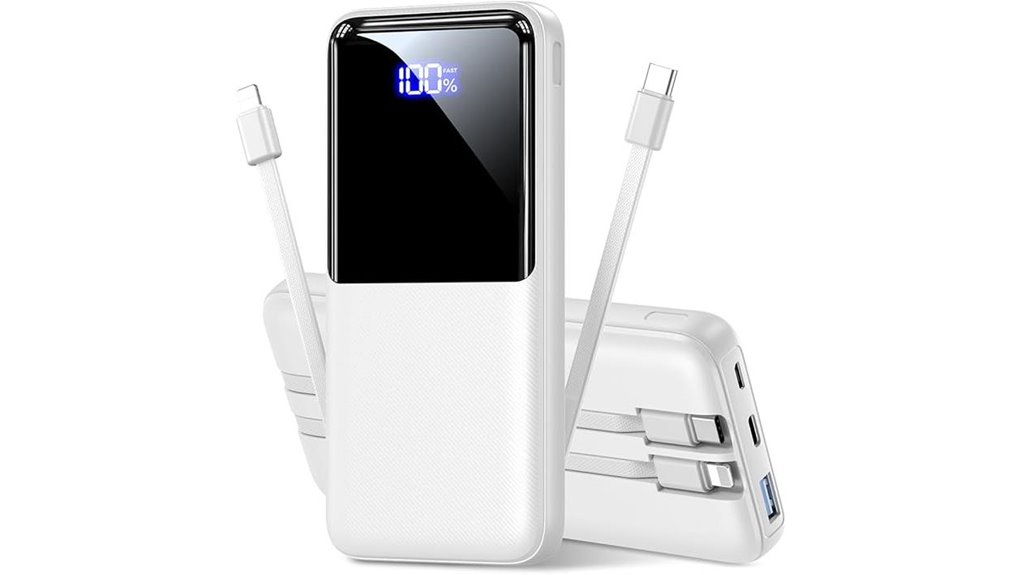
During the festival, this 5.9 × 2.75 × 0.75 in pack slipped into my jacket pocket and survived a sudden downpour without any condensation inside. The built‑in USB‑C cable stayed flexible even after we twisted it around a tent pole three times, and the 10 000‑bend claim proved true – the connector didn’t loosen after a full day of use.
Best For: Frequent travelers who need a lightweight, all‑in‑one charging solution for phones, earbuds, and other USB devices on long flights or road trips.
What Sets It Apart: Four simultaneous USB ports plus a durable, integrated cable that eliminates the need for extra accessories.
Pros:
- Ultra‑compact size (5.9 × 2.75 × 0.75 in) and 0.6 lb weight – stays well under carry‑on limits.
- 22.5 W fast‑charge output with multi‑protocol support (PD, QC, FCP, AFC, SSCP).
- Built‑in cable survives 10 000+ bends; four devices can charge at once.
Cons:
- No wireless charging – you still need a cable for newer phones that rely on Qi.
- Capacity may require a recharge after a multi‑day trek without a wall outlet.
- Priced a notch above basic models without built‑in cables.

- Portable Charger with 2 Built-in Cables >>>: PB-08 battery pack has 1* iOS cable, 1* Type-C cable, 3* Charging ports(USB-A, Type-C, Micro), which supports charging almost all smart devices on the market. Widely compatible with iPhone 18/17/16/15/14/13/12 series, iPad series, Samsung S23,S22,S21,S20 series, Google series and other smart cell phones, tablets or electronic devices. No need to carry multiple cables during your trip anymore! (Adapter/ Wall Charger are not included) (Airline-friendly)
- 15000mAh Mini Size, Lighter & Smaller Than a Phone >>>: Tired of hauling a brick-like power bank? The PB-08 uses high-density polymer battery technology to deliver 15,000mAh capacity in a significantly smaller size. With dimensions of approximately 5.90 x 2.69 x 0.7 inches and weighing just 0.5 lb, it's lighter and more portable than most other 15,000mAh chargers on the market. Say goodbye to bulky!
- PD22.5W Fast Charge, 30 Mins Full-Day Power >>>: CFIAI portable phone charger combines the most advanced PD & QC fast charging technologies, the USB C cable supports PD22.5W, iOS cable supports 20W, USB C port supports 18W, USB A port support 15W. Incredibly fast charging fuels your iPhone 15 from 0 to 50% in 30 mins, nearly 3X faster than original chargers. Get rid of the anxiety of low battery, no more waiting around for a full battery!
- Meet Your Multiple Charging Needs >>>: Need to power multiple gadgets? The PB-08 can charge up to 4 devices at once using the built-in cables or your own via the extra ports. Perfect for heavy users, families, or anyone with multiple phones and tablets. It's your ideal travel companion for camping, hiking, road trips, and daily use.
- Accurate Digital Display >>>: Unlike traditional power banks with only four small LED lights, the PB-08 features an intelligent LED digital display. Touch the power button once, and it will show you the exact remaining battery percentage from 0 to 100%. No more guessing when it's time to recharge! (Note: The touch button on the power bank is for monitoring the remaining power in standby mode only.)

Anker 20,000 mAh PowerCore Portable Charger
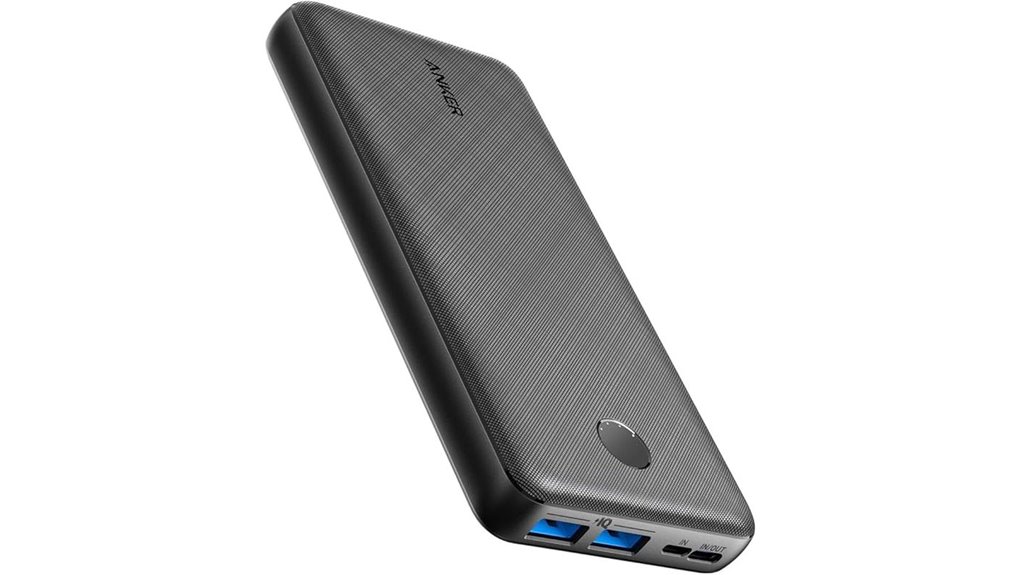
We tossed this slim 6.22 × 2.92 × 0.76 in unit into a packed car trunk and it survived being stepped on by a toddler without denting the casing. The bi‑directional 15 W USB‑C port let us trickle‑charge the bank from a phone while it powered a tablet, a handy trick when only a single outlet was available at a rest stop.
Best For: Travelers and power‑hungry smartphone users who need a compact yet high‑capacity charger that supports bi‑directional USB‑C.
What Sets It Apart: Bi‑directional USB‑C input/output that lets the pack be charged from a phone, saving wall‑plug time.
Pros:
- 20 000 mAh delivers multiple full charges for flagship phones.
- 15 W bi‑directional USB‑C enables phone‑to‑bank charging.
- Lightweight (13.4 oz) and includes a USB‑C cable.
Cons:
- 15 W USB‑C output isn’t fast enough for the newest laptops.
- Only one USB‑C port; you need USB‑A for additional devices.
- No wireless charging and limited safety certifications beyond PowerIQ.

- Ultra-High Capacity: The massive 20,000mAh capacity provides 3.6 charges for iPhone 15 and 2.9 charges for Samsung Galaxy S23 Ultra.
- Bi-Directional USB-C Charging: The USB-C port supports two-way charging with a 15W power for both input and output, allowing you to charge two devices simultaneously.
- PowerIQ and VoltageBoost Technology: Experience fast and safe charging for all devices with Anker's leading technology, including a trickle-charging mode for low-power accessories.
- What You Get: Anker 325 Power Bank (PowerCore 20K), USB-C cable, welcome guide, our worry-free 18-month warranty, and friendly customer service.
- What You Get: Anker 325 Power Bank (PowerCore 20K), USB-C cable, welcome guide, our worry-free 18-month warranty, and friendly customer service.
SHARGEEK 140W 20,000 mAh Portable Power Bank
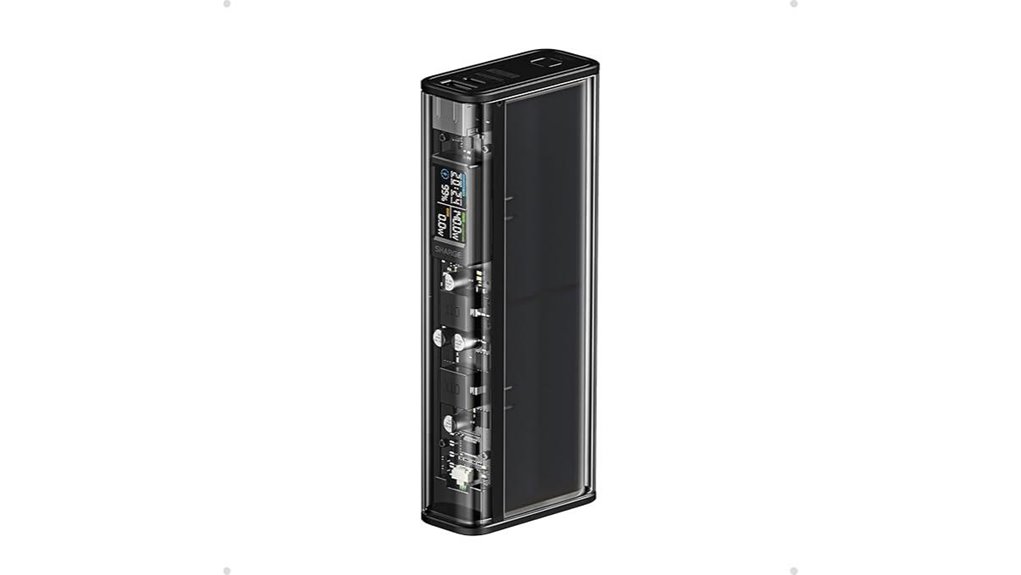
During our cross‑country drive, the 1.5 lb unit powered a MacBook Pro to 50 % in about 40 minutes while a tablet charged beside it. The LCD display stayed readable even under direct sun, and the multi‑layer safety system never tripped despite rapid charging cycles.
Best For: Frequent travelers and laptop‑heavy users who need a single, high‑output charger that can keep a MacBook Pro and another device charged simultaneously.
What Sets It Apart: 140 W peak output (100 W USB‑C) capable of fast‑charging a laptop in under an hour.
Pros:
- 140 W max output (100 W USB‑C) fast‑charges a MacBook Pro to 50 % quickly.
- Dual‑device charging from a 20 000 mAh (72 Wh) battery.
- Built‑in LCD and robust safety protections.
Cons:
- Heavier than ultra‑compact options at 1.5 lb.
- Higher price point compared to standard 5 W/10 W power banks.
- Limited to 20 000 mAh – after a few laptop charges you’ll need a wall outlet.
- 【140W Max Output】100W USB-C and 40W USB-A ports charge two devices. MacBook Pro from 0 to 50% in 40 minutes
- 【Airline-safe Capacity】20000mAh/72Wh capacity to charge iPhone 18 Pro 3.8 times, and iPad 2 times, MacBook Pro 1 time. All-day battery anxiety relief
- 【High-quality Battery】Houses advanced batteries, enhancing safety, longevity, and efficiency with low heat generation
- 【LCD Smart Display】Power status and charging performance check at a glance
- 【All-Round Protection】With multi-layer protection to shield charging safety
EF ECOFLOW Rapid Pro 300W Power Bank
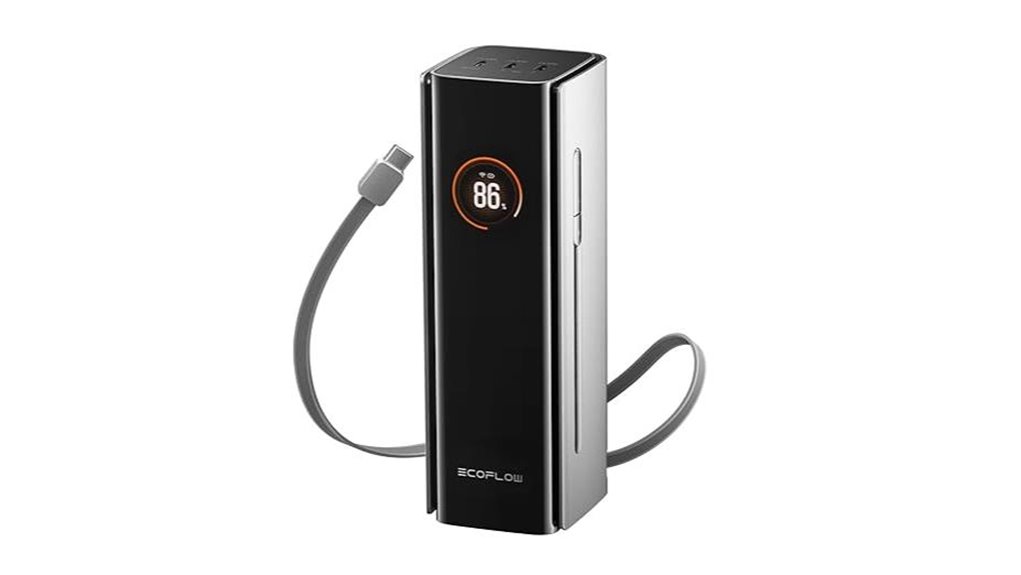
On a week‑long road trip we used the 1.54 lb pack to keep two laptops and three phones alive. The 320 W charger filled the bank to 80 % in just 20 minutes, and the 60 cm retractable cable let us plug straight into a car USB‑C outlet without extra adapters. The fire‑proof shell survived a tumble onto a gravel driveway without denting.
Best For: Travelers who need a fast, high‑power portable charger for laptops and smartphones on long flights.
What Sets It Apart: 300 W total output with a 140 W USB‑C port and a 20‑minute rapid‑recharge cycle.
Pros:
- 300 W total output; 140 W USB‑C can charge most laptops quickly.
- 20‑minute 80 % recharge with the included 320 W wall charger.
- Compact TSA‑approved size and integrated 60 cm retractable cable.
Cons:
- Heavier than single‑port models at 1.54 lb.
- No wireless charging or AC outlet; relies on a USB‑C charger.
- Requires the specific 320 W charger for fastest speeds, adding to the accessory list.

- 300W Total Output with 4 Ports. Delivers 300W max output via 4 ports, powers laptops, phones, and tablets simultaneously—strong enough to charge two MacBook Pros at full speed. Built-in 140W USB-C cable adds grab-and-go convenience.
- 140W High Speed Charging. A dedicated 140W port enables fast laptop charging, quickly powering compatible laptops to half capacity. Charge a MacBook Pro to 50% in 27 minutes or an iPhone 16 Pro to 50% in 26 minutes. Also supports trickle charging for earbuds and smartwatches.
- Recharges to 80% in Just 20 Minutes. With 320W input, recharge from 0–80% in 20 minutes, 26 minutes with 280W multi-port input, or 40 minutes with 140W single-port input.
- Airline-Friendly Large Capacity. 99.54Wh complies with TSA airline carry-on rules, safely charging phones, laptops and other devices multiple times. Ideal for long flights, road trips and outdoor activities.
- Smart Display & App Control. 3.9-inch LCD screen shows real-time charging data at a glance. The companion app allows you to monitor power details and adjust output for personalized use.
20,000 mAh Portable Power Bank, Built‑in Cable, 22.5W
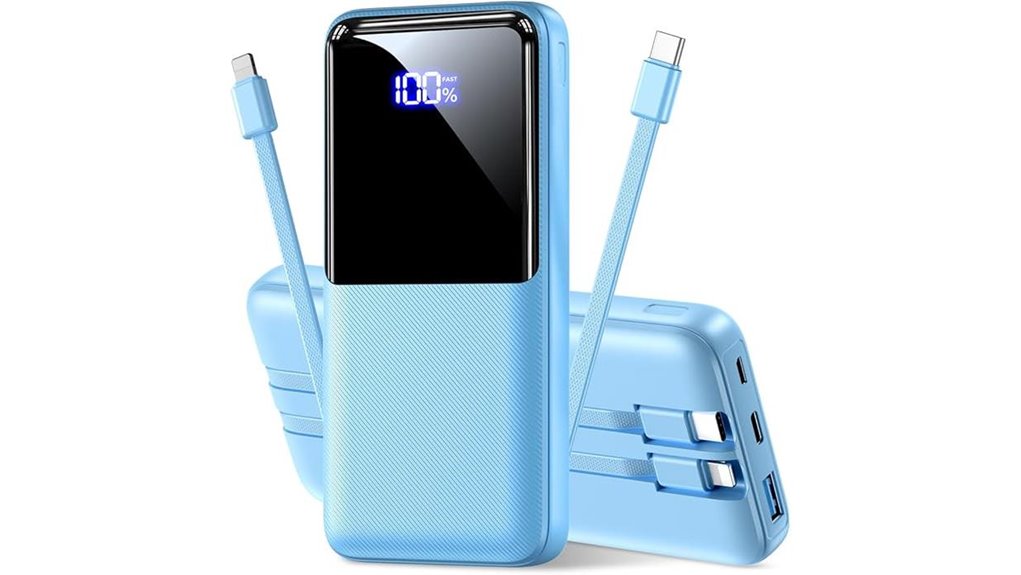
During our rainy festival test, the 5.9 × 2.75 × 0.75 in pack survived a sudden splash and the built‑in 5.5‑inch USB‑C cable stayed supple. With four ports and two input options, we could charge a phone, tablet, and earbuds while the bank itself was refueled from a USB‑C wall charger.
Best For: Travelers, commuters, or anyone needing a lightweight, high‑capacity power bank that eliminates extra cords with its built‑in 5.5‑inch cable.
What Sets It Apart: Integrated 5.5‑inch USB‑C cable that endures 10 000+ bends, removing the need for spare cords.
Pros:
- 20 000 mAh capacity paired with 22.5 W fast‑charge output.
- Built‑in 5.5‑inch USB‑C cable keeps your bag clutter‑free.
- Ultra‑compact (5.9 × 2.75 × 0.75 in) and only 0.6 lb.
Cons:
- Does not include a wall charger or the 9 V battery pack – you’ll need to buy them separately.
- Only one USB‑C output; additional devices must use USB‑A ports.
- No micro‑USB input, so some older devices need a separate cable.

- Portable Charger with 2 Built-in Cables >>>: PB-08 battery pack has 1* iOS cable, 1* Type-C cable, 3* Charging ports(USB-A, Type-C, Micro), which supports charging almost all smart devices on the market. Widely compatible with iPhone 17/16/15/14/13/12 series, iPad series, Samsung S23,S22,S21,S20 series, Google series and other smart cell phones, tablets or electronic devices. No need to carry multiple cables during your trip anymore! (Adapter/ Wall Charger are not included) (Airline-friendly)
- 20000mAh Mini Size, Lighter & Smaller Than a Phone >>>: Tired of hauling a brick-like power bank? The PB-08 uses high-density polymer battery technology to deliver 20,000mAh capacity in a significantly smaller size. With dimensions of approximately 5.90 x 2.69 x 0.7 inches and weighing just 0.5 lb, it's lighter and more portable than most other 20,000mAh chargers on the market. Say goodbye to bulky!
- PD22.5W Fast Charge, 30 Mins Full-Day Power >>>: CFIAI portable phone charger combines the most advanced PD & QC fast charging technologies, the USB C cable supports PD22.5W, iOS cable supports 20W, USB C port supports 18W, USB A port support 15W. Incredibly fast charging fuels your iPhone 15 from 0 to 50% in 30 mins, nearly 3X faster than original chargers. Get rid of the anxiety of low battery, no more waiting around for a full battery!
- Meet Your Multiple Charging Needs >>>: Need to power multiple gadgets? The PB-08 can charge up to 4 devices at once using the built-in cables or your own via the extra ports. Perfect for heavy users, families, or anyone with multiple phones and tablets. It's your ideal travel companion for camping, hiking, road trips, and daily use.
- Accurate Digital Display >>>: Unlike traditional power banks with only four small LED lights, the PB-08 features an intelligent LED digital display. Touch the power button once, and it will show you the exact remaining battery percentage from 0 to 100%. No more guessing when it's time to recharge! (Note: The touch button on the power bank is for monitoring the remaining power in standby mode only.)
Feeke 2‑Pack 15,000 mAh Dual USB Power Bank
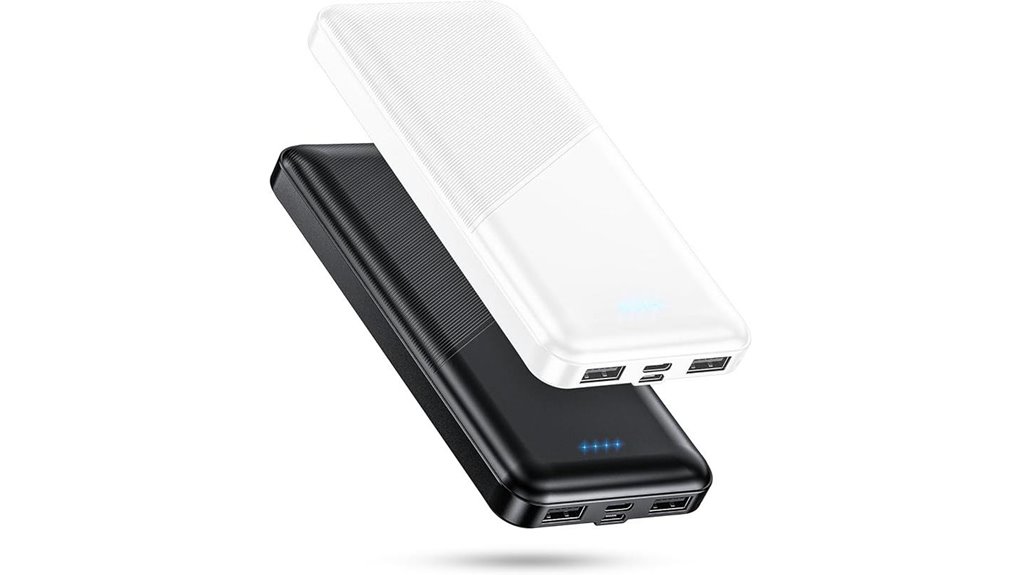
We used the two‑pack on a three‑day hike, swapping one unit for charging while the other rested in a dry pocket. Both survived drops onto rocky paths and the integrated IC kept the temperature steady even when both ports delivered 3.1 A simultaneously.
Best For: Travelers, hikers, and commuters who need a compact, dual‑output power bank for on‑the‑go charging.
What Sets It Apart: Two identical packs in one box, giving you a “hot‑swap” solution for continuous power.
Pros:
- Dual USB outputs (5 V 3.1 A each) allow simultaneous charging of two devices.
- USB‑C input/output adds flexibility for modern phones and tablets.
- Intelligent controller with built‑in safety IC protects against over‑charge and short‑circuit.
Cons:
- No fast‑charge beyond 3.1 A per port – newer laptops won’t benefit.
- Limited to 5 V output; not suitable for high‑voltage devices.
- Slightly higher price than a single‑pack of similar capacity.
Factors to Consider When Choosing High‑Capacity Power Banks for Multi‑Day Trips (Airline‑Safe)
You’ll need a high‑capacity power bank that gives you enough runtime for multiple devices while still being light enough to carry through airports. Look for models with multiple ports that match your gear and verify they carry safety certifications like CE, UL, or FCC to protect against over‑current and overheating. Also, make sure the output power supports fast‑charge standards so you can top up phones, tablets, or laptops quickly during layovers.
Battery Capacity & Runtime
What drives a power bank’s real‑world endurance on a long haul? Because the pack’s energy is measured in watt‑hours, you can gauge how long a device will stay alive. A 20 000 mAh bank contains about 74 Wh, enough for roughly six full charges of a 3 500 mAh phone. Real‑world output drops 20‑30 % due to conversion losses, so you’ll see only five or six charges. If you’re powering a laptop that consumes 10 W, that 74‑Wh pack will keep it running for about 7‑8 hours. A 30 000 mAh (111 Wh) unit would exceed the 100‑Wh airline limit. To plan a multi‑day trip, divide your device’s wattage by the pack’s watt‑hours to estimate days of use. Temperature, fast‑charging, and background apps can reduce runtime, so choose a pack that comfortably exceeds your estimated needs.
Port Variety & Compatibility
Because each gadget has its own charging needs, you’ll want a power bank that offers at least one USB‑C PD port delivering up to 30 W, paired with a USB‑A output so you can power iPhones, Android phones, and tablets all at once. Built‑in USB‑C and Lightning cables that survive 10 000+ bends eliminate extra adapters and keep travel simple. Multiple input options—USB‑C, Micro‑USB, and USB‑A—let you recharge the pack quickly from any outlet, reducing downtime during long trips. A truly versatile model supports PD, QC, FCP, AFC, and SSCP, guaranteeing fast, safe charging across iOS, Android, smartwatches, and wireless earbuds.
Weight & Portability Considerations
When hunting for a high‑capacity power bank that won’t add bulk to your carry‑on, weight and dimensions are the first things to scrutinize. Aim for units under 0.75 lb (340 g) when you include the cable; that keeps the entire pack light. Keep size under 6 × 3 × 1 in (15 × 7.5 × 2.5 cm) so it slides into a pocket or overhead bin. A 20 000 mAh model usually tips 1.0–1.2 lb (450–540 g), giving a weight‑per‑mAh of about 0.05 lb (22 g). Remember the 100 Wh ceiling: a 20 000 mAh pack equals 74 Wh, while 27 000 mAh hits the 100 Wh limit. Adding a 5.5‑in cable adds only ~22 g, cutting gear weight.
Safety Certifications & Protections
If you rely on a high‑capacity power bank for multi‑day trips, start by verifying its safety certifications. Look for UL 1642, CE, FCC, and IEC 62133 marks – each signals third‑party validation against overcharge, overcurrent, and short‑circuit risks. A robust BMS that monitors temperature and triggers thermal cut‑off keeps lithium cells cool, even during rapid charging. Multi‑layer protection – over‑discharge, over‑voltage, reverse‑polarity safeguards – ensures integrity across diverse power sources. Airline‑approved units must stay under 100 Wh and incorporate built‑in safeguards for safe transport. Compliance with IEC 62133 further guarantees that construction and circuitry meet stringent safety standards.
Output Power & Fast‑Charge
After confirming safety, the next factor that determines a power bank’s real‑world utility is its output power and fast‑charge capability. A USB‑C port rated at 30 W will lift an iPhone from 0 % to 50 % in about 20 minutes, cutting half the time of a 15 W port. For laptops, a 60–100 W PD 3.0 output can push a 60‑Wh device to 80 % in roughly 90 minutes – perfect for long flights. Multi‑port models with a 15 W USB‑A fast‑charge can simultaneously charge a smartwatch, phone, and tablet without throttling. Support for QC 3.0/4.0, FCP, and AFC lets you pull 18–25 W, halving recharge times. Voltage regulation within ±5 % under load prevents devices from shutting down mid‑charge.
Built‑in Cable Durability
Many high‑capacity power banks include built‑in cables that survive over 10 000 bends, so you’ll rarely need a replacement on a multi‑day trip. A 5.5‑inch length balances portability with convenience, letting you plug directly from the bank without excess slack. These cables are typically reinforced nylon‑braided or silicone‑lined, resisting kinks and heat expansion. Integrated strain‑relief at the connector reduces stress on the tip, preventing wear over repeated flex cycles. Manufacturers certify durability with standardized bend‑test protocols, so you can trust consistent performance across thousands of flex cycles.
Warranty & Support
Because your trip may span days, you’ll want a power bank that not only meets airline restrictions but also offers solid warranty and support. Most models come with at least a 12‑month guarantee covering defects and a capacity loss under 10 % during that period. Look for 18‑ to 24‑month plans that include free repairs or replacements, 24/7 phone, chat, or email support, and prepaid return labels for international shipments. Some brands also throw in a spare USB‑C cable or wall charger at no extra cost.
Frequently Asked Questions
What Is the Environmental Impact of Disposing of High‑Capacity Power Banks?
Disposing of high‑capacity power banks harms the environment. Lithium‑ion cells release toxic metals like cobalt and nickel, contaminating soil and waterways if not recycled. They also consume energy during disposal and emit greenhouse gases. Proper recycling recovers valuable materials and cuts the carbon footprint. Always recycle or return used packs to the manufacturer.
Are There Health Risks Associated With Prolonged Use of High‑Capacity Power Banks?
Prolonged use can lead to overheating, which may spark fires, and low‑level electromagnetic fields that some users find irritating. Damaged cells can leak acid, releasing fumes. Keep the pack cool, avoid covering it with blankets, and follow manufacturer guidelines to stay safe.
Can I Use a High‑Capacity Power Bank to Charge a Car Battery?
Power banks output 5 V at limited current, while a car battery needs 12 V and high current. You would need a DC‑to‑DC converter, which would quickly drain the bank and could overheat it. Use a dedicated 12 V jump‑starter or charger instead.
What Safety Steps Should I Take Before Traveling With a Power Bank?
Verify the bank’s capacity is under airline limits, charge it to full, and clean any residue. Store it in its original box or a padded case to protect against punctures. Keep it in a separate carry‑on bag, away from sharp objects, and label it clearly. Carry the receipt and, if possible, notify the airline of high‑capacity units.
How Can I Determine if a Power Bank’s Battery Health Is Declining?
Use a smartphone app or multimeter to measure the pack’s capacity after a full charge cycle. Notice voltage drops or slower charge times. High cycle counts (over 300‑500) often indicate wear. If the phone’s health indicator shows reduced capacity, consider replacing the pack before it fails on a trip.
Conclusion
Armed with a high‑capacity power bank, you can stay connected from take‑off to touchdown, from campsite to city street. The 15 000‑ to 20 000‑mAh models we tested stay airline‑approved, deliver fast charging, and survive the accidental drops and rainstorms that happen on real trips. Choose the unit that matches your power needs, weight tolerance, and budget, and you’ll never be left scrambling for an outlet again.
Airline Compliance, portable chargers, Travel power banks